Download Original PDF
Get the official Barkatullah University print version scanned document.
🤝 Help Your Juniors!
Have previous year question papers that aren't on our website? Help the next batch of students by sending them to us! With your consent, we will proudly feature your name as a Top Contributor on our platform.
Submit Papers 📩Roll No.
Total No. of Questions : 5
[Total No. of Printed Pages : 4]
EXS-69
B.Tech. Ist Semester (CSE.IT & Elect.)
Examination, 2023
Paper - BE-101
Engg Mathematics-I
Time : 3 Hours
[Maximum Marks : 60]
Note :- Attempt all questions. All question carry equal marks.
Attempt any two parts from each question.
1. (a)
Define Evolutes and Involutes with suitable examples.
2. (a)
Prove that
$\int_0^{\pi/2} \sqrt{\sin \theta} \, d\theta \int_0^{\pi/2} \frac{1}{\sqrt{\sin \theta}} \, d\theta = \pi$
(b)
Prove that
$\int_0^{\pi/2} \sqrt{\tan x} \, dx = \frac{\pi}{\sqrt{2}}$
(c)
Test the convergency of the series :
$1 + \left(\frac{1}{2}\right)^2 + \left(\frac{2}{3}\right)^3 + \left(\frac{3}{4}\right)^4 + \ldots$
3. (a)
Find the Fourier series expansion for the periodic function
$f(x) = x; 0 < x < 2\pi$
(b)
Expand $f(x) = \pi x - x^2$ in a half-range sine series in the interval $(0, \pi)$ upto the first three terms.
(c)
Reduce the matrix A to echelon form and, hence, find its rank, where
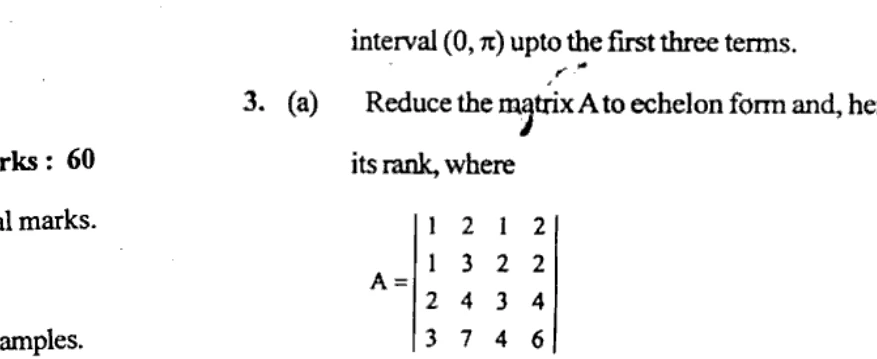
$A = \begin{bmatrix} 1 & 2 & 1 & 2 \\ 1 & 3 & 2 & 2 \\ 2 & 4 & 3 & 4 \\ 3 & 7 & 4 & 6 \end{bmatrix}$
4.
$x + y + z = 6,$
$x + 2y + 3z = 14,$
$x + 4y + 7z = 30$
are Consistent and solve them.
(c)
Find the eigenvalues and any one eigenvector of the given matrix A, where
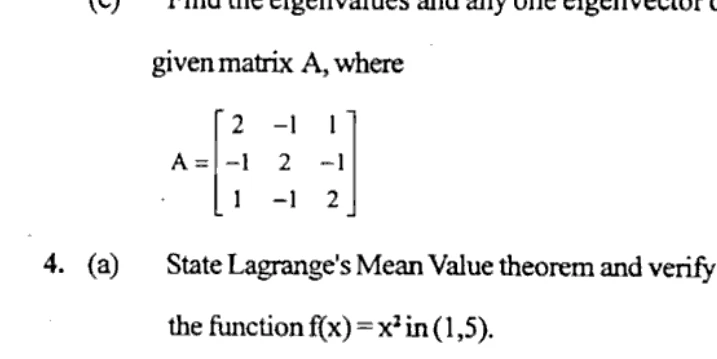
$A = \begin{bmatrix} 2 & -1 & 1 \\ -1 & 2 & -1 \\ 1 & -1 & 2 \end{bmatrix}$
4. (a)
State Lagrange's Mean Value theorem and verify it for the function $f(x) = x^2$ in $(1,5)$.
(b)
Verify Taylor's theorem for $f(x) = (1-x)^{1/2}$ with Lagrange's form of remainder upto 2 terms in the interval $[0,1]$.
(c)
find the Shortest distance from origin too the surface $xyz^2=2$.
5. (a)
Prove that the set of all diagonal matrices over R is a vector space with respect to matrix addition and scalar multiplication.
(b)
Write the vector u = (2, -5, 4) as Linear Combination of vectors V1 = (1, -3, 2), and V2 = (2, -1, 1) in vector space V3(R).
(c)
Show that the function. T: R3 → R3 difined by T(x,y) = (x+1, 2y, x+y) is not a Linear transformation.