Download Original PDF
Get the official Barkatullah University print version scanned document.
🤝 Help Your Juniors!
Have previous year question papers that aren't on our website? Help the next batch of students by sending them to us! With your consent, we will proudly feature your name as a Top Contributor on our platform.
Submit Papers 📩
Roll No. ........................
Total No. of Questions: 05
Total No. of Printed Pages: 04
Total No. of Printed Pages: 04
AR-39
B.Sc.-B.Ed. (Reg./ATKT) Examination, 2024
(Third Semester)
MATHEMATICS
(3.2 Differential Equation)
Time: 3 Hours
Maximum Marks: 30
Note : All questions are compulsory. All question carry equal marks. Attempt any two parts from each questions.
(c)
Solve Recurrence relation for $J_n(x)$ :
(i)
$$ \frac{d}{dx} (x^n J_n(x)) = x^n J_{n-1}(x) $$
(ii)
$$ \frac{d}{dx} (x^{-n} J_n(x)) = -x^{-n} J_{n+1}(x) $$
1.
(a)
Define Power Series. Solve by power series method $y'' - y = 0$.
(b)
Express $f(x) = x^4 + 2x^3 - 2x^2 - 2$ in terms of Legendre's polynomials.
2.
(a)
Show that the function $1, \cos x, \sin x, \cos 2x, \sin 2x, \dots$ form an orthogonal set on an interval $-\pi \le x \le \pi$ and obtain orthonormal set.
(b)
Find the eigen values and Eigen functions of the Sturm-Liouville problem:
$$ \frac{d^2y}{dx^2} + \lambda y = 0 $$
(i)
$y(0) = 0$ and $y(\pi) = 0$.
(c)
Prove that:
$$ \int_{-1}^{1} P_n(x) dx = 0, \text{ if } n \ge 1 $$
3.
(a)
Find :
(i)
$L \{ \sin at \}$
(ii)
$L \{ \cos at \}$.
(b)
Find :
(i)
$L \{ e^t \sin^2 t \}$
(ii)
$L \{ e^t \cos^2 t \}$.
(c)
Find the Laplace transformation of the following functions:
(i)
$f(t) = t \sin^2 t$
(ii)
$f(t) = t \cos^2 t$.
4.
(a)
Construct a partial differential equation by eliminating arbitrary Constants $a$ if: $z = a(x + y)$
5.
(a)
Solve :
$$ \frac{\partial z}{\partial x} - \frac{\partial z}{\partial y} = x + y + z $$
(b)
Solve :
$$ p + r + s = 1 $$
(c)
Solve :
$$ \frac{\partial^2 z}{\partial x^2} - 2 \frac{\partial^2 z}{\partial x \partial y} + \frac{\partial^2 z}{\partial y^2} = \frac{1}{x^2} $$
(c)
Solve :
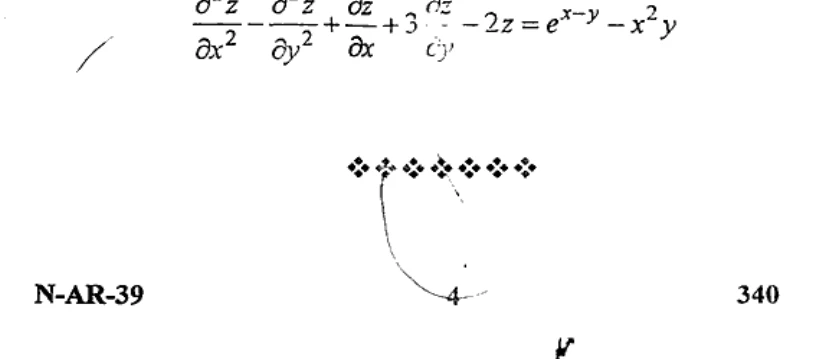
$$ \frac{\partial^2 z}{\partial x^2} + \frac{\partial^2 z}{\partial y^2} - 2z = e^{x-y} - x^2y^2 $$