Download Original PDF
Get the official Barkatullah University print version scanned document.
🤝 Help Your Juniors!
Have previous year question papers that aren't on our website? Help the next batch of students by sending them to us! With your consent, we will proudly feature your name as a Top Contributor on our platform.
Submit Papers 📩Total No. of Questions : 11
[Total No. of Printed Pages : 8
EF-396
M.Sc. IIIrd Semester (New/ATKT)
Examination, 2021-22
Chemistry
Paper - I
Application of Spectroscopy
Time : 3 Hours]
[Maximum Marks : 85
Note :- Attempt all the questions.
SECTION - 'A'
Objective Type Questions 10×1=10
1. Choose the correct answer :
(i) In which region of the electromagnetic spectrum does an absorption at 600 nm come ?
- Near -UV
- Infrared
- Vacuum -UV
- Visible
(ii) What does the notation σ*←n mean ?
- Absorption: transition from a non-bonding MO to σ* MO
- Absorption: transition from a quantum level n to σ* MO
- Emission: transition from a quantum level n to σ* MO
- Emission: transition from a non-bonding MO to σ* MO
(iii) Which molecule or ion has D3h symmetry ?
- [H2O]+
- CHCl3
- [CO3]2-
- NF3
(iv) Which of othe following statements regarding NMR spectroscopy is wrong ?
- NMR signals towards the left of the spectral chart correspond to larger chemical shifts
- Chemical shifts are larger when the frequencies of the radiation which induces the nuclear transi- tions are higher
- Chemical shifts are larger when shielding effects are greater.
- A hydrogen signal splits into n-1 peaks by spin-spin coupling when the number of equivalent hydrogen atoms on adjacent atoms (s) is n. and no other neighbouring atoms are involved.
(v) Which of (a)-(d) indicates the correct order of carbon chemical shifts of the four carbons of the following compound
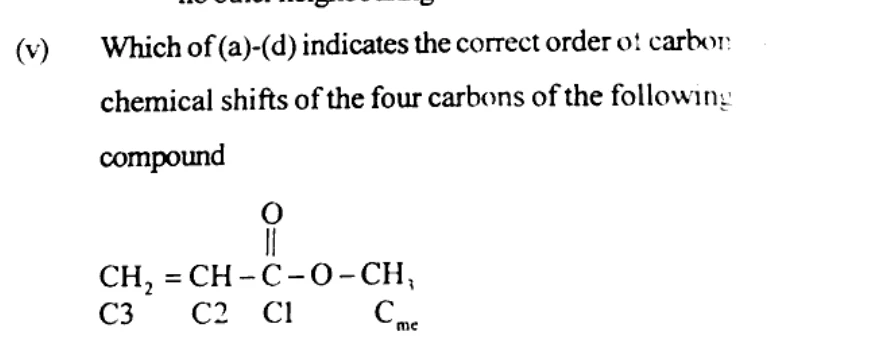
- CMe < C2 < C3 < C1
- CMe < C3 < C2 < C1
- CMe < C2 < C1 < C3
- CMe < C1 < C2 < C3
(vi) How many signals does the aldehyde (CH3)3 CCH2CHO have in 1H NMR and 13C NMR spectra ?
- Five 1H signals and six 13C signals
- Three 1H signals and four 13C signals
- Five 1H signals and four 13C signals
- Three 1H signals and six 13C signals
(vii) Which hydrogen of 1-chloropent-2-ene shows the largest chemical (downfield) shift in its NMR spectrum
- The h on c1
- The h on either c2 or c3
- The h on c4
- The h on c5
(viii) An NMR transmitter consists of:
- Frequency synthesizer, RF signal generator, trans- mitter controller and receiver
- CPU, RF signal generator, transmitter controller, and RF amplifier
- Frequency synthesizer, RF signal generator, and transmitter controller
- Frequency synthesizer, RF signal generator, trans- mitter controller, and RF amplifier
(ix) Samples prepared for Moessbauer spectroscopy should be in which phase ?
- Any phase
- Liquid
- Solid
- Vapour
(x) The correct value of isomer shift (in Mossbauer spectra) and its explanation for Fe (II) - TPP and Fe (III) - TPP respectively from the following are : (TPP = Tetraphenyl porphyrinate)
- 0.52mms-1
- 0.45mms-1
SECTION - 'B'
Short Answer Type Questions 5×5=25
Explain admixture of states differing in d, allows 'spin forbid- den transitions', especially in heavy metal atoms.
OR
Draw a graph of the Octahedral Site Preference Energies for high spin d5 -d10 electron configurations.
Whate is the molecular shape of C2F6.
OR
Discuss the principle of raman spectroscopy ?
Explain Spin Hamiltonian and Spin densities ?
OR
Discuss the Theory of chemical shift.
Discuss about karpius curve-variation of coupling constant.
OR
What is the nuclear overhauser effect (NOE).
Explain basic principles, of mossbauer spectroscopy.
OR
What is mossbauer spectroscopy explain.
SECTION - 'C'
Long Answer Type Questions 5×10=50
Give the relevant selection rules for electronic transitions in high spin first row transition metal complexes. What factors can lead to their violation ?
OR
Write Information note on following ?
- Jahn-Teller Distortions
- Hole Formalism
- d-d transitions: spin forbidden
Describe the mode of bonding of nitrosyl ?
OR
Describe the application of raman spectroscopy ?
Explain the spin spin interaction in NMR spectroscopy ?
What is karplus curve-variation coupling constant ? Discuss its disordered.
What is the sπ4 compounds nature of M-L bond ? When ever a high energy bounding and structures of fe+2 compound explain.