Download Original PDF
Get the official Barkatullah University print version scanned document.
🤝 Help Your Juniors!
Have previous year question papers that aren't on our website? Help the next batch of students by sending them to us! With your consent, we will proudly feature your name as a Top Contributor on our platform.
Submit Papers 📩Roll No............................................
Total No. of Questions : 11
Total No. of Printed Pages : 07
OP-499
M. Sc. (Reg./Pvt./ATKT) Examination, 2024
(Fourth Semester)
MATHEMATICS
Paper Compul.
Functional Analysis-II
Time : 3 Hours]
[Maximum Marks :
[Reg. : 85
[Pvt. : 100
Section A
(Objective Type Questions)
Note : Attempt all questions.
10×1=10
1.
Select the correct option :
(i)
Hilbert adjoint operator T* satisfies which of the following conditions ?
(a) <Tx, y> = <x, T*-1y>
(b) <T*x, y> = <x, T*y>
(c) <Tx, y> = <x, T*y>
(d) <Tx, y> = 0
(a) <Tx, y> = <x, T*-1y>
(b) <T*x, y> = <x, T*y>
(c) <Tx, y> = <x, T*y>
(d) <Tx, y> = 0
(ii)
If T is an operator on Hilbert space H with <Tx, x> = 0; ∀ x then :
(a) T = 0
(b) T ≠ 0
(c) T is not defined
(d) None of the above
(a) T = 0
(b) T ≠ 0
(c) T is not defined
(d) None of the above
(iii)
A partially ordered set A, which is finite has at least how many maximal element ?
(a) 0
(b) 1
(c) 2
(d) ∞
(a) 0
(b) 1
(c) 2
(d) ∞
(iv)
Real valued functional p on a vector space X is subadditive if :
(a) p(x + y) = p(x) + p(y)
(b) p(x + y) > p(x) + p(y)
(c) p(x + y) ≤ p(x) + p(y)
(d) p(x + y) < p(x) + p(y)
(a) p(x + y) = p(x) + p(y)
(b) p(x + y) > p(x) + p(y)
(c) p(x + y) ≤ p(x) + p(y)
(d) p(x + y) < p(x) + p(y)
(v)
If T is represented by a Matrix then the adjoint operator T* is represented by :
(a) Inverse of Matrix
(b) Transport of Matrix
(c) Determinant
(d) None of the above
(a) Inverse of Matrix
(b) Transport of Matrix
(c) Determinant
(d) None of the above
(vi)
If a normed space X is reflexive then it is:
(a) Vector space
(b) Banach Space
(c) Metric Space
(d) Topological Space
(a) Vector space
(b) Banach Space
(c) Metric Space
(d) Topological Space
(vii)
A subset M of a metric space X is said to be nowhere dense in X if its closure M̅ is :
(a) no interior points
(b) many interior points
(c) limit points
(d) None of the above
(a) no interior points
(b) many interior points
(c) limit points
(d) None of the above
(viii)
A sequence (xn) in a normed space X is said to be strongly convergent if ∃ x ∈ X such that :
(a) ||xn - x|| = 0
(b) ||xn - x|| ≥ 0
(c) limn→∞ ||xn - x|| = 0
(d) limn→∞ ||xn - x|| = ∞
(a) ||xn - x|| = 0
(b) ||xn - x|| ≥ 0
(c) limn→∞ ||xn - x|| = 0
(d) limn→∞ ||xn - x|| = ∞
(ix)
If T ∈ B(X, Y), where X is Banach space and Y a normed space. <Tn> is strongly operator convergent with limit T; then :
(a) T ∈ B(X, Y)
(b) T ∈ B(X, X)
(c) T ∈ B(Y, Y)
(d) None of the above
(a) T ∈ B(X, Y)
(b) T ∈ B(X, X)
(c) T ∈ B(Y, Y)
(d) None of the above
(x)
If (X, d) be a metric space. A mapping T : X → X is called contraction ion X if ∃ positive real number α < 1 such that ∀ x, y ∈ X :
(a) d(Tx, Ty) ≥ α d(x, y)
(b) d(Tx, Ty) > α d(x, y)
(c) d(Tx, Ty) < α d(x, y)
(d) d(Tx, Ty) ≤ α d(x, y)
(a) d(Tx, Ty) ≥ α d(x, y)
(b) d(Tx, Ty) > α d(x, y)
(c) d(Tx, Ty) < α d(x, y)
(d) d(Tx, Ty) ≤ α d(x, y)
Section B
(Short Answer Type Questions)
Note : Attempt all questions.
5×5=25
2.
If the operators U : H → H and V : H → H be unitary, where H is a Hilbert space then prove that :
(i)
U is Normal
(ii)
A bounded linear operator T on a complex Hilbert space H is unitary iff T is isometric and subjective.
Or
3.
Define Partially ordered set and normed linear space. Write statement of Zorn's Lamma.
Or
If f(x) = f(y) for every bounded linear functional f on a normed space X, then show that x = y.
4.
Define Canonical mapping and Reflexivity.
Or
Prove that every Hilbert space is Reflexive.
5.
If <xn> be a sequence in a Normed space X, if dim X < ∞ then prove that weak convergence implies strong convergence.
Or
Show that in a Normed space X, xn —w→ x if and only if for every element f of a total subset M ⊂ X' we have f(xn) → f(x).
6.
State and prove open mapping theorem.
Or
Define convergence of sequences of operators and functionals.
Section C
(Long Answer Type Questions)
Note : Attempt all questions.
5×10=50
7.
Prove that Hilbert adjoint operator T* of T exists, it is unique and is a bounded linear operator with norm
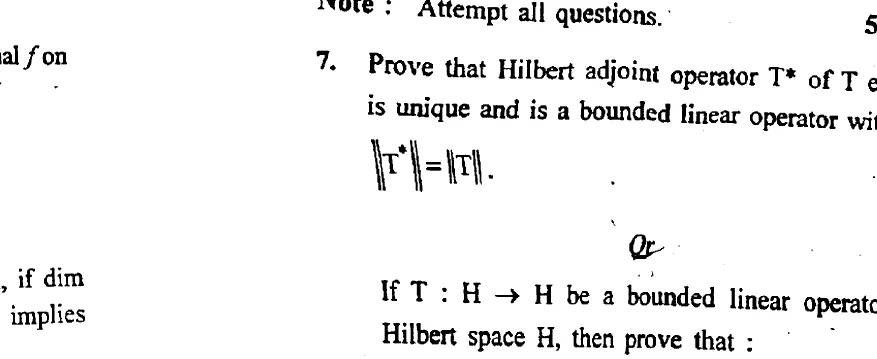 .
.
Or
If T : H → H be a bounded linear operator on a Hilbert space H, then prove that :
(i)
If T is self adjoint <Tx, x> is real ∀ x ∈ H.
(ii)
If H is complex and <Tx, x> is real, ∀ x ∈ H, operator T is self adjoint.
8.
State and prove Hahn Banach theorem for Real Linear Spaces.
Or
State and prove Hahn-Banach theorem for complex Vector spaces.
9.
Explain the relation between the adjoint operator T* and the Hilbert adjoint operator T*.
Or
If the Dual Space X' of a Normed space X is separable then prove that X itself is separable.
10.
State and prove Baire's category theorem.
Or
State and prove Uniform Boundedness theorem.
11.
State and prove closed Graph theorem.
Or
State and prove contraction theorem.